
Reading: At the foundation level
🌼 Introduction: Why I Started With This
This is my first blog—and I chose to begin with something very basic, yet deeply important.
Over the years, working closely with Kindergarten classrooms, I have repeatedly observed one growing concern:
👉 Children today are struggling to develop strong reading skills at the foundational level.
This is not about ability. It is about approach, environment, and changing learning patterns.
It made me reflect:
- Why are children finding it harder to focus?
- Why are teachers finding it challenging to build reading readiness?
- Where are we, as educators and parents, going wrong?
🌍 What Is Changing in This Generation?
Today’s children are growing up in a very different environment.
They are exposed to:
- Increased screen time
- Fast-paced visuals (YouTube, reels, cartoons)
- Instant information and quick responses
While these are not entirely negative, they are impacting key developmental areas:
👉 Reduced attention span
👉 Difficulty in sustained focus
👉 Limited listening patience
👉 Weak fine motor coordination
👉 Reduced real-world interaction
👉 Passive learning habits
🧠 Real Classroom Observation
In classrooms, I’ve seen children:
- Struggle to sit through a short reading activity
- Lose interest quickly when repetition is involved
- Recognise visuals faster than sounds
- Prefer watching over doing
👉 This directly affects how they learn to read.
⚠️ Where Are We Going Wrong?
Often, without realising, we:
- Introduce reading too quickly
- Focus on memorisation instead of understanding
- Depend heavily on worksheets
- Replace interaction with screens
👉 And most importantly, we miss building the foundation.
🌱 Why This Blog?
This thought led me to a simple decision:
👉 Why not begin with the most essential skill—reading?
Because when reading is strong:
- Learning becomes easier
- Confidence improves
- Thinking develops naturally
🔍 What Actually Works
Reading is not about memorising words.
It is about:
- Recognising sounds
- Connecting sounds to letters
- Understanding meaning
👉 When these are built correctly, reading becomes natural.
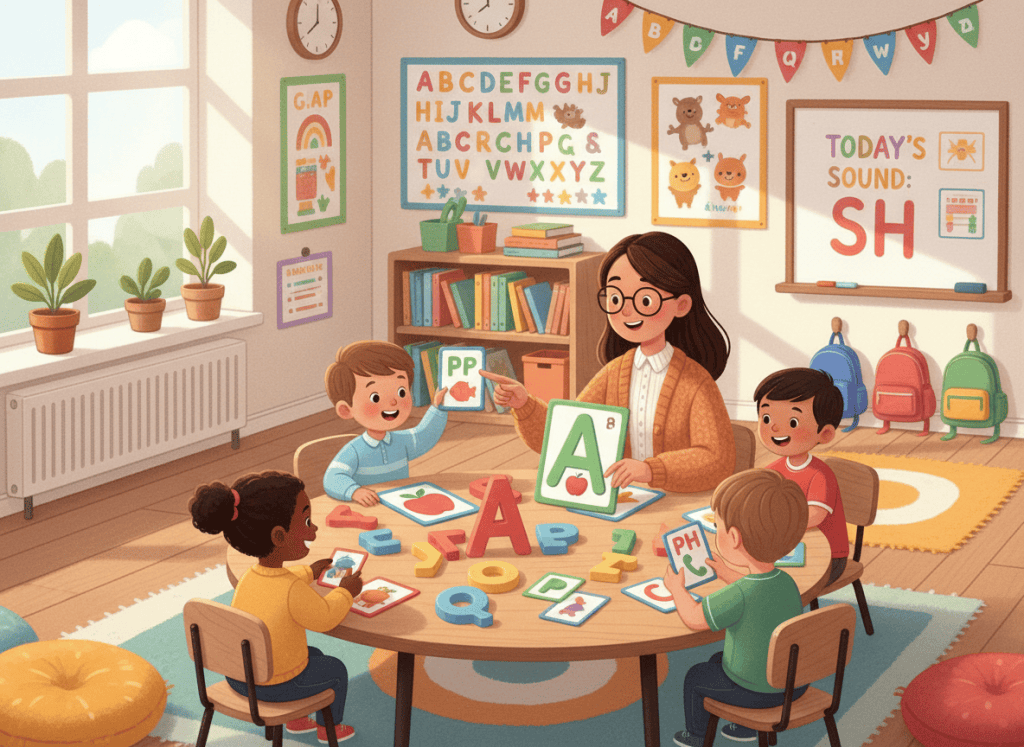
🔤 Step 1: Focus on Sounds Before Words
Instead of:
❌ “A for Apple”
Teach:
👉 The sound “a”
🎲 Activities That Work


6
- Clap sounds: “c-a-t”
- Identify starting sounds with pictures
- Sound hunt in classroom
🧠 Real Experience
When I shifted from word-based teaching to sound-based learning:
✔ Children started decoding independently
✔ Guesswork reduced
✔ Confidence increased
🎭 Step 2: Make Reading Active
Children learn best when they are involved.
🎯 Try This


7
Ask:
👉 “Show me something that starts with ‘b’”
Let them:
- Move
- Point
- Speak
🧠 Classroom Insight
When learning becomes active:
✔ Attention improves
✔ Engagement increases
✔ Learning stays longer
🔁 Step 3: Repeat with Purpose
Repetition is important—but not repetition of the same method.
🎯 Example
Teaching “b”:
- Day 1 → Picture cards
- Day 2 → Objects in class
- Day 3 → Game
- Day 4 → Story
🧠 Real Experience
When we changed repetition style:
✔ Participation increased
✔ Understanding became visible
✔ Children enjoyed learning
🌟 Final Thought
Reading is not something we “finish teaching.”
It is something we build carefully.
Strong readers are not created through speed or pressure—
they are built through clarity, consistency, and meaningful practice.
🤝 A Shared Responsibility
This is not just the responsibility of teachers.
It is a collective effort of:
- Teachers
- Parents
- Schools
- Community
👉 When we work together, children thrive.
🚀 Action Step (Start Today)
Start small.
👉 Focus on one sound this week
👉 Use different activities
👉 Reduce passive screen exposure
👉 Increase interaction
Observe the change.
💬 Before You Leave
Ask yourself:
👉 Are children learning to read—or just recognising words?
That answer can change everything.
🌿 Closing Note
This blog is just the beginning.
Through FoundEd Space, I will continue to share:
- Practical strategies
- Real classroom insights
- Simple solutions that actually work
If this resonated with you, share it with someone who works with young learners.
Because strong foundations don’t just support learning—they shape the future.


Leave a Reply